

COMPARE

Board vs. Anaplan

Looking for an alternative to Anaplan?

Anaplan has shifted toward pre-packaged applications, a dual-engine architecture, and value-based pricing. While this approach aims to accelerate time-to-value, it introduces prohibitive, cosh heavy pricing, architectural disconnection and complexity, and rising costs as organizations scale.

Board delivers a unified, AI continuous planning platform that adapts to your business without architectural trade-offs or unpredictable pricing.

Compare Board and Anaplan in this guide.

Why Board is better for enterprise planning.  

Comprehensive enterprise finance solution

Board combines planning, forecasting, consolidation, and reporting in one native, unified platform unlike Anaplan, which acquired Fluence Technologies for financial consolidation – a separate tool designed for SMB.

Enterprise-ready AI persona based, domain specialized Agents

Board Agents are persona-based and domain specific spanning FP&A, Controlling, Merchandising, and Supply Chain solutions. They analyze performance data, generate scenarios, uncover trends, detect anomalies, aid demand planning, and more.

Harness 5M+ external economic indicators with predictive AI

Natively combine internal metrics with 5m+ external economic signals and insights from industry-leading economists to proactively adapt strategies ahead of changing conditions and driving resilient performance.

Compare Board and Anaplan.

One Engine vs Dual-Engine Complexity

Anaplan operates with two separate engines—Classic and Polaris—while Board delivers a single unified architecture. This difference has significant implications for scalability, risk, and long-term maintainability.

Board provides a future-proof platform. Anaplan introduces architectural risk.

BoardAnaplan
One Engine

Board is built on a single, unified engine that supports all planning use cases without architectural trade-offs.

• No migration between engines
• Consistent performance across use cases
• Simplified development and maintenance
Dual-Engine Complexity

Anaplan requires customers to choose between Classic and Polaris, with no migration path between them.

• Full rebuild required to switch engines
• Split roadmap and capabilities
• Increased complexity in implementation and support

Predictable Pricing vs Escalating Cost Model

Anaplan has shifted to a “value-based pricing model” tied to company size, use cases, users, and applications. While positioned as value-driven, this model introduces significant cost variability as organizations expand with Anaplan’s new licensing model positioning it among the higher-cost EPM vendors. As adoption expands, managing cost often becomes an increasingly important factor for customers.
 
Board delivers predictable cost. Anaplan introduces pricing volatility and long-term TCO risk.

BoardAnaplan
Predictable Pricing

Board offers transparent, predictable pricing that scales with your business without forcing additional applications or cost drivers.

• Clear pricing aligned to usage and value
• No forced upgrades at renewal
• Lower and more predictable total cost of ownership
Escalating Cost Model

Anaplan’s pricing model increases cost as planning scope expands and new applications are introduced.

• Platform fee based on employees and use cases
• User licensing tiers
• Additional application fees
• No like-for-like renewals

Future-Proof Platform vs Forced Re-platforming

As Anaplan evolves its architecture around Polaris, customers are increasingly pushed toward adopting the new engine to access advanced capabilities.

Board ensures continuity. Anaplan forces re-platforming.

BoardAnaplan
Future-Proof Platform

Board enables continuous evolution without disruption, allowing organizations to scale their planning environment seamlessly.

• No re-platforming required
• Continuous scalability across use cases
• Stable architecture over time
Forced Re-platforming

Anaplan’s transition toward Polaris introduces significant migration challenges for customers.

• Full model rebuilds required to adopt new capabilities
• Additional implementation costs and timelines
• Increased project risk

Proven Platform vs Catching-Up Architecture

Anaplan’s recent innovations aim to address historical limitations in scalability and data handling. However, these capabilities require architectural changes and new technologies.

Board was built for modern planning from day one. Anaplan is still adapting.

BoardAnaplan
Proven Platform

Board was designed from the ground up to support modern enterprise planning requirements.

• Native sparsity management
• High-performance, large-scale modeling
• Modular and scalable architecture
Catching-Up Architecture

Anaplan has introduced new capabilities through Polaris to address prior limitations.

• Requires separate engine adoption
• Still evolving in maturity and adoption
• Introduces architectural complexity

Integrated Financial Planning and Consolidation

Enterprise planning requires seamless integration between planning, reporting, and financial consolidation.

BoardAnaplan
Integrated Approach

Board provides a fully integrated platform for planning, analytics, and financial consolidation.

• Single unified data model
• No need for external tools
• Consistent logic across all processes
Separate Platforms

Despite Anaplan working to integrate their acquisition of Fluence for consolidation and close into their platform, it remains a separate solution with its own architecture and data model. While integrated at the workflow level, Fluence does not operate on the same platform, requiring data synchronization and introducing additional complexity.

• Separate tools and integrations required
• Increased complexity and maintenance
• Fragmented user experience

More Value, Lower Total Cost

As organizations scale planning across the enterprise, cost efficiency becomes a critical factor. Board delivers the same outcomes with greater cost efficiency and control.

BoardAnaplan
More Value, Lower Total Cost

Board delivers enterprise-grade planning capabilities with a lower and more predictable cost structure.

• Scale across use cases without multiplying cost drivers
• Reduce reliance on additional tools and integrations
• Optimize long-term total cost of ownership
Increasing Cost Structure

Anaplan’s cost structure increases as organizations expand their planning footprint.

• Costs grow with each new use case and application
• Pricing tied to organizational size and scope
• Long-term TCO risk increases over time

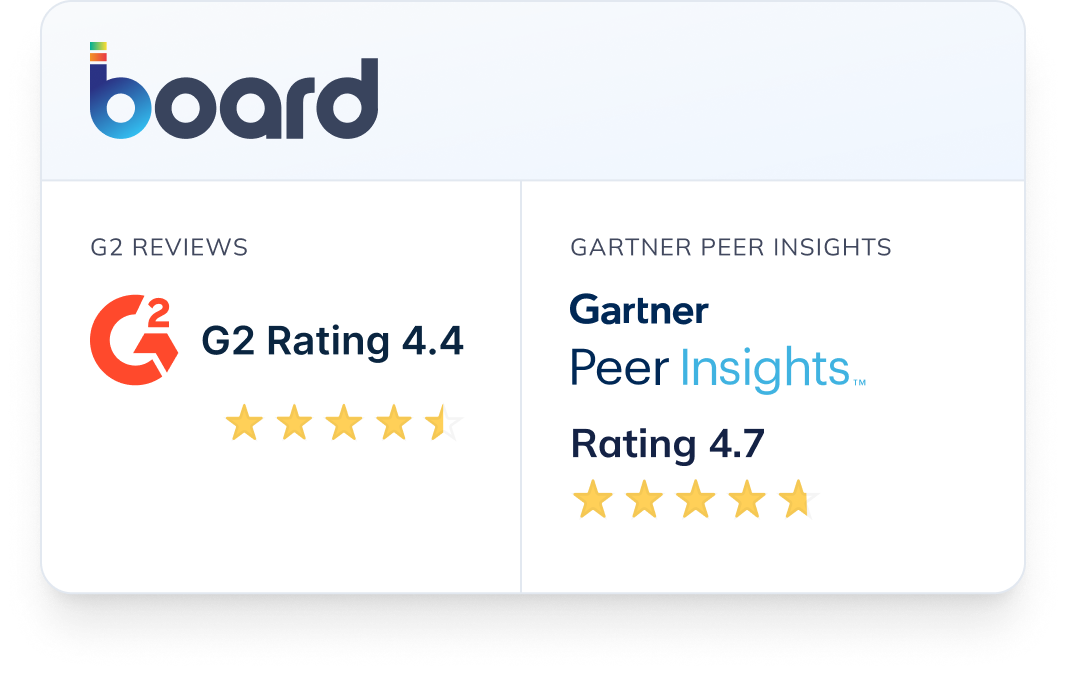
Board is recognized by analysts, peers, and industry experts.

See all recognition

Don’t just take our word for it.

Thousands of leading enterprises plan with Board.

Coca-Cola logo

Automated 90% of financial data input

Coca-Cola implemented Board to automate 90% of financial data input, reducing data transfer time from 24-hours to 15-minutes, enabling driver-based planning across production, supply chain, and logistics for full visibility and consolidation in one-click.

Read the case study
Mitsubishi Electric logo

Accelerated sales decisions from 10-hours to 2-seconds

Mitsubishi Electric chose Board to replace inflexible, manual reporting with a unified, real-time planning platform powering their full sales, forecasting, and planning process across divisions, accelerating sales analysis, reporting, and performance decisions from 10-hours to 2-seconds.

Read the case study
Toyota logo

Standardized PBF across 40 companies

Toyota standardized financial planning, budgeting, and forecasting across 40 companies, replacing disparate spreadsheets with a unified solution supporting different methodologies, including zero-based budgeting and driver-based planning.

Read the case study

FAQs

Board Agents drive collaborative intelligence designed around role-based personas (e.g. FP&A, FCCR, Merchandising, Supply Chain) to collaborate with your planning teams to deliver more confident decisions.

Yes. Board supports a “bring-your-own-model” approach. Even if your data is on-premises, you can seamlessly integrate through REST APIs and built-in connectors such as Azure ML Studio, Databricks, R, and Snowflake. These connect directly into our Microsoft Azure cloud system, ensuring smooth integration and scalability.

Board is designed to meet 100% of enterprise-level scaling requirements. Board’s Enterprise Tier infrastructure meets 99.3% of customer scaling needs with our standard configuration. It manages all scaling requirements seamlessly, without adding any complexity for the customer.

With Flex Grid, Board enables users to analyse, enter, edit, and drill into millions of records in real-time. Its high-performance grid ensures smooth interaction with massive datasets and no front-end lag.